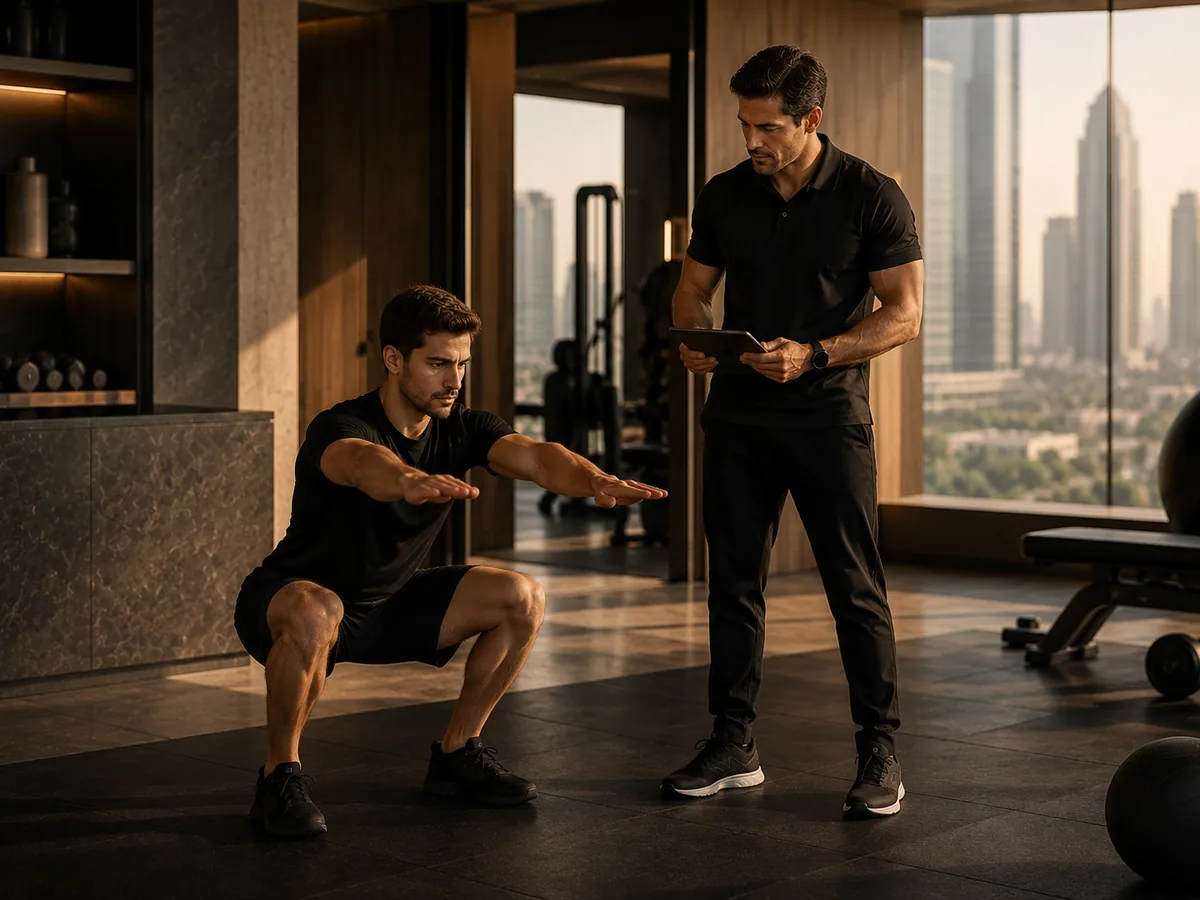
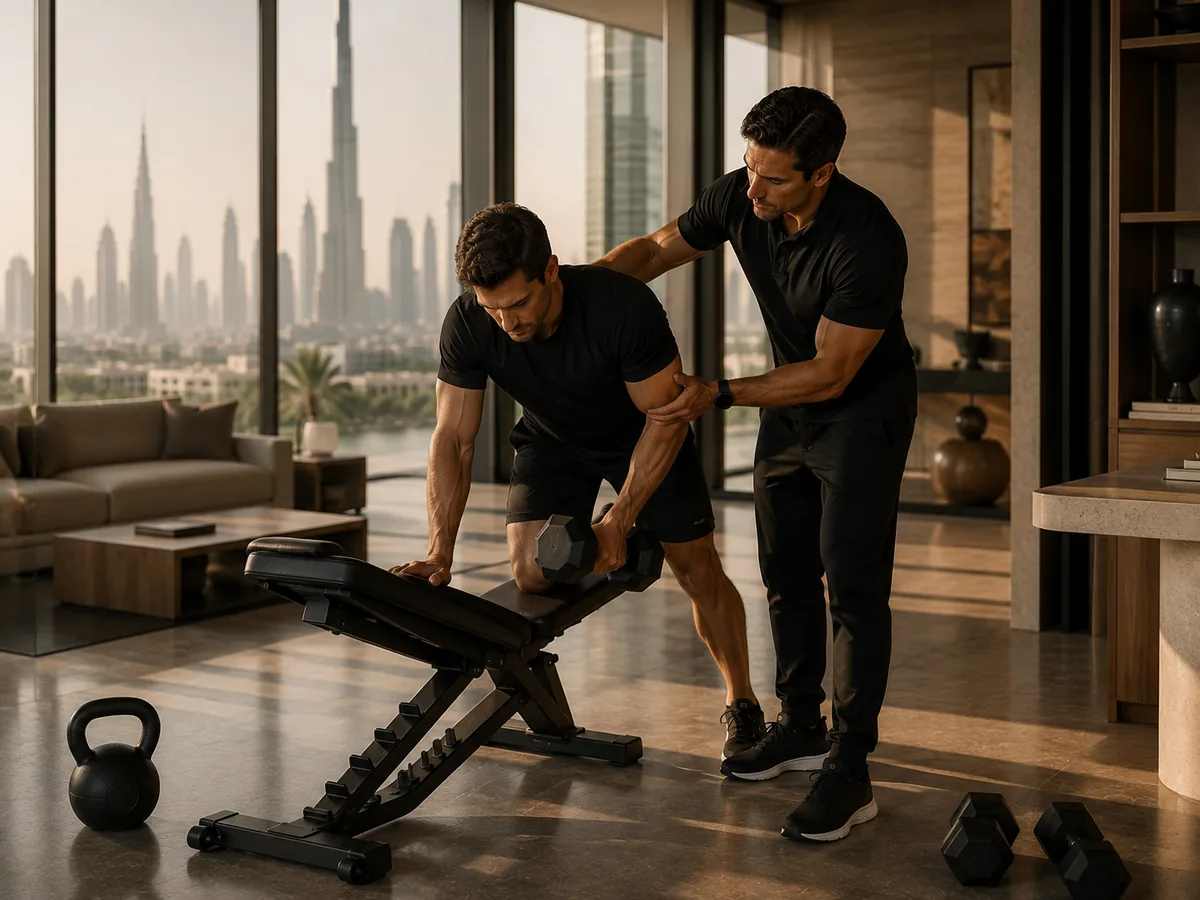
Most people interview a personal trainer for about as long as it takes to read a price list. They glance at an Instagram grid, exchange a few messages, enjoy a free intro session, and commit to a package that will absorb hours of their week and a meaningful budget for months. In a city with thousands of trainers and almost no friction to calling oneself a coach, that is a surprisingly large decision made on surprisingly little information.
The professionals we work with — founders, executives, people who relocated to Dubai for the pace and now struggle to protect an hour for themselves — would never sign a vendor or a hire on that basis. They would ask questions, and listen as carefully to how something was answered as to what was said. The person who will manage your body deserves the same rigour.
This guide is the interview. It sets out the fifteen questions worth asking before you commit to a personal trainer in Dubai, organised by what they actually tell you — and, just as importantly, what a strong answer sounds like versus a weak one. It is written to make you a better buyer, not to sell you a coach. If you would prefer the broader decision framework first, our companion guide on how to choose the right personal trainer in Dubai covers the wider picture; this article is the conversation itself.
Key takeawayMost people commit to a personal trainer after little more than a price list and a free session. The people who choose well treat it like any important hire — asking the right questions first about method, assessment, tracking and fit, so the decision rests on substance rather than marketing.
Why the Right Questions Matter More Than the Right Gym
The most expensive mistake in personal training is choosing on impression. The trainer with the most polished feed is not necessarily the one who will keep you injury-free, and the most charismatic person in the room is often just the best at converting consultations. Neither charisma nor a good gym tells you whether someone can assess your body, design around your constraints and hold you accountable through a hard quarter.
Good questions cut through that quickly. They surface competence, compliance and fit in a single conversation, and shift the dynamic in your favour: a professional welcomes scrutiny because it is how they demonstrate value, while an amateur turns vague the moment questions get specific. You are not being difficult by asking — you are doing exactly what a serious coach wants from a serious client.
There is also a Dubai-specific reason the right questions matter. The Dubai personal training market runs from unlicensed freelancers working out of a building gym to the best personal trainers in Dubai running structured executive fitness programmes — and the labels people market themselves with, whether “luxury personal trainer”, “premium” coach or simply “fitness coach”, reveal almost nothing on their own. Price does not reliably separate them either. The questions below do.
The 15 Essential Questions to Ask Before You Commit
You do not need to interrogate anyone. A relaxed twenty-minute conversation, in person or on a call, will cover all of this — and the quality of the thinking behind the answers will tell you more than any single fact.
Questions about qualifications and credentials
1. Which certifications do you hold, and are you registered with REPs UAE? This is the floor, and it is non-negotiable. A credible trainer holds an internationally recognised qualification — typically a Level 3 Diploma in Personal Training or equivalent from a body such as NASM, ISSA or ACE. In the UAE there is an added layer: fitness professionals are generally expected to be registered with REPs UAE (the Register of Exercise Professionals) and to hold appropriate local licensing or approval where applicable, within a framework associated with the Dubai Sports Council. A strong answer names the qualification and confirms registration without hesitation. A weak answer pivots to “I've been doing this for years” — experience is valuable, but not a substitute for credentials you can verify.
2. Do you carry professional liability insurance, and are you certified in first aid and CPR? This rarely comes up, which is exactly why it is revealing. Reputable coaches carry liability cover and hold current first-aid and CPR certification, and they can say so immediately. It matters more, not less, when sessions happen in your home or a private building, where there is no front desk and no facility cover behind them.
3. Do you have any specialist qualifications relevant to my situation? Fat loss, strength, rehabilitation, pre- and post-natal training, training for clients over fifty, or working around hypertension and old injuries are genuinely different disciplines. You are listening for honesty about scope. The best answer is specific — “yes, that's a large part of my work, here's how I'd approach yours” — or a candid “that's not my specialism, but I can refer you to someone whose it is.” Both are signs of a professional.
Questions about experience and specialisation
4. How long have you been coaching, and who do you work with most? Years are a weak proxy; relevance is everything. Ten years of coaching twenty-two-year-old athletes may be the wrong decade of experience for a forty-five-year-old executive with a reconstructed knee and a punishing calendar. You want a coach whose typical client looks something like you.
5. Have you worked with clients like me, and can you share references? A specific yes — same life stage, comparable starting point, similar goal — is worth more than a confident generalisation. Established coaches keep a small list of clients happy to act as references; a willingness to connect you with one is a strong signal, and reluctance is worth noting.
Questions about results and how they are measured
6. How do you assess a new client before designing a programme? This one question separates coaches from session-providers faster than any credential. Look for a real process: a movement screen, a conversation about history, sleep, stress and lifestyle, and clear baseline measurements before any programme is written. “We'll just start training and see how you go” is the most common — and most serious — warning sign in the market.
7. How do you measure progress, and how often do we review it? Good coaching is accountable to data, not mirror talk. Look for objective markers — strength numbers, girth measurements, photographs, performance benchmarks, sometimes bloodwork in partnership with your doctor — reviewed on a defined schedule. A coach who cannot tell you how you will both know it is working is asking you to pay on faith.
Questions about accountability and support
8. What support do I get between sessions? A training week contains far more hours outside the session than in it, and those hours decide most of your result. Ask what happens on the other six days: check-ins, a channel to message, adjustments when life intervenes. This is often the real difference between a trainer and a coach.
9. What happens if I miss a session or travel? Frequent travel is a fact of executive life in Dubai, not an excuse. A mature coach has a fair, clear policy and — more importantly — a plan to keep you progressing while you are away, whether through a remote programme, a hybrid coaching arrangement, or structured online performance coaching for the weeks you are out of the country.
Questions about lifestyle integration
10. How will training fit around a demanding, unpredictable schedule? The best programme is the one that actually happens. Ask how the coach handles early mornings, last-minute changes and the weeks when work simply takes over. You want flexibility built into the system, not a rigid template that collapses the first time a meeting overruns.
11. Do you train clients at home or in another private setting? For many busy professionals this is the decisive question. Private personal training in Dubai at your residence or building gym removes the commute, the parking and the crowded floor — the three places where consistency usually dies — and a coach experienced in villa and apartment-gym training understands how to deliver a complete session around limited space and family life.
Questions about nutrition
12. How is nutrition handled — included, referred, or separate? Training and nutrition are inseparable, but how a coach covers nutrition varies enormously. Some include structured guidance, some partner with a registered dietitian for clinical needs, some leave it entirely to you. There is no single right model, but there is a right answer for you — and you need to know which you are buying before you compare it on price.
Questions about scheduling and logistics
13. What does your availability look like, and how are sessions and cancellations handled? Practical, but it prevents the most common friction. Clarify availability against your real schedule, how packages are structured, and the cancellation policy. You are checking that the logistics fit a life that does not always cooperate. For how pricing works across the market, our guide on what personal training costs in Dubai breaks down the ranges.
Questions about privacy and discretion
14. How do you handle privacy, confidentiality and discretion? For high-profile clients, founders and anyone who simply values their privacy, this is not a small matter. Ask how the coach treats your information, your results and your image — whether progress photos stay private, whether they are comfortable with a confidentiality agreement, and how they conduct themselves around a household. Discretion is part of a premium service, and a professional will not be surprised by the question.
Questions about communication and coaching style
15. How would you describe your coaching style, and how do you prefer to communicate? Personal training is personal. You will spend a great deal of time with this person, often at your least composed, so the relationship has to work. Some clients want a calm, technical guide; others want to be pushed. Neither is better — but the mismatch is miserable. Ask directly, and trust how the conversation itself feels, because that is a live sample of what every session will be like.
Common Mistakes People Make When Interviewing a Trainer
Even people who ask good questions often undermine the process. The most common error is buying on the free session alone — an hour designed to feel great rather than to reveal how the coach assesses, plans and measures. A trial is useful, but treat it as one data point, not the decision.
Another is comparing the per-session price instead of the whole system. A lower rate that includes nothing but the hour can easily be more expensive, in money and time, than a higher rate that includes assessment, programming, nutrition guidance and between-session support. Compare like for like, or you are not really comparing at all.
People also over-index on physique: a coach being in great shape proves they can train themselves, not that they can assess and program for a deconditioned client twice their age. Many skip the references entirely — the most reliable source of truth, and one most trainers will provide if asked. And the quiet mistake: not noticing how it feels to be questioned. That reaction previews the entire relationship.
Red Flags and Green Flags: How to Read the Answers
The questions only work if you know how to read the answers. A handful of signals reliably separate professionals from the rest.
Red flags
Be cautious with anyone who guarantees a dramatic, fixed result by a fixed date; who wants to start training with no assessment of any kind; whose programme sounds identical to the one their last client posted online; who is vague or evasive about certification, REPs UAE registration or insurance; who leans on urgency and “today only” pricing; or who responds to reasonable questions with irritation. Individually, some of these can have an innocent explanation. Together, they describe someone selling sessions rather than outcomes.
Green flags
The reassuring signals are quieter. A strong coach asks you more questions than you ask them, because they cannot programme responsibly without understanding your history and your life. They talk in terms of assessment and measurement, not slogans. They are specific about people they have helped who resemble you, and comfortable providing references. They have a clear, fair policy for travel and missed sessions. And they are entirely at ease being interviewed — because to them, your diligence is a sign you will be a serious client, which is exactly who they want.
How V-ITAITALY Approaches These Questions
We have set out these questions in the open because we would rather you choose well — including elsewhere — than choose us uninformed. They also happen to describe how we work, so it is fair to answer them ourselves.
Our coaches are qualified and registered to practise in Dubai, and we are glad to confirm credentials and insurance on request rather than ask anyone to take them on trust. Every engagement begins with a genuine individual assessment — movement, history, lifestyle and goals — before a single session is programmed, and progress is reviewed against clear, objective markers, so results are something we can show, not just claim. Accountability is built in rather than sold as an add-on: structure for the intense weeks, sensible adjustments for travel, and continuity through in-home, hybrid or online formats when your schedule demands it. The experience is deliberately private and considered, because discretion and consistency matter to the people we serve. You can read the backgrounds of our team of coaches and more about V-ITAITALY, and judge the answers for yourself — evidence first, decision second.
Conclusion
Hiring a personal trainer in Dubai is not really about who has the best gym, the leanest physique or the busiest feed. It is about who can safely assess you, design for the life you actually live, measure what matters and keep you consistent when the week falls apart. Fifteen good questions, asked calmly and listened to carefully, tell you almost everything you need to know — long before any money changes hands.
Use them. Take the answers seriously, trust how the conversation feels, and choose the coach whose process survives your scrutiny. And if you would like a considered, no-pressure conversation about what the right coaching solution might look like for you — whether that turns out to be us or simply a clearer sense of what to look for — you are welcome to speak with our team. The first useful step is always a good conversation.
Frequently Asked Questions
What questions should I ask before hiring a personal trainer in Dubai?
Start with qualifications and REPs UAE registration, then ask how they assess new clients, how they measure progress, what support you get between sessions, what happens if you travel, and how they handle privacy and communication. The reasoning behind the answers matters more than any single fact.
How do I check whether a personal trainer in Dubai is qualified?
Ask for their certification (a Level 3 Diploma or equivalent from NASM, ISSA or ACE is the baseline) and confirm they are registered with REPs UAE and appropriately licensed where applicable. A professional will confirm this readily; vagueness on the subject is a warning sign.
Should a personal trainer assess me before we start training?
Yes. A proper assessment — a movement screen, a conversation about history and lifestyle, and baseline measurements — should happen before any programme is written. Starting to train with no assessment is the most common serious red flag in the market.
How do I know if a personal trainer is right for my goals?
Ask whether they have worked with clients like you, how they would approach your specific goal, and request references. A coach whose typical client resembles you, and who can describe a clear plan for your situation, is a far safer choice than a generalist.
Is it worth hiring an in-home personal trainer in Dubai?
For many busy professionals, yes. In-home and villa training removes commuting, parking and crowded gyms — the main reasons consistency breaks down — and suits anyone who values privacy and time. The trade-off is a modest premium over a comparable gym rate.
How often should I train with a personal trainer?
Most clients start with two to three sessions per week. Three tends to accelerate fat loss and strength because the coach has more opportunities to correct technique and build momentum, but the right frequency depends on your goal, recovery and schedule.
What are the biggest red flags when choosing a personal trainer?
Guaranteed dramatic results by a fixed date, no assessment before training, one-size-fits-all programmes, vagueness about certification or insurance, high-pressure “today only” pricing, and irritation at reasonable questions.
Will a personal trainer also help with my nutrition?
It varies. Some include structured nutrition guidance, some partner with a registered dietitian for clinical needs, and some focus on training only. Clarify which model a coach offers before comparing them on price, because it materially changes the value.
How much does a personal trainer in Dubai cost?
Rates vary widely by format, seniority and setting, so it is best to judge value rather than the headline number. Our dedicated guide to personal training costs in Dubai breaks the ranges down in detail.