You train consistently for three weeks, step on the scale expecting a reward, and the number has not moved, or worse, it has gone up. It is a familiar and slightly demoralising moment, and it is also usually a measurement problem rather than a training problem. Body weight on any given morning reflects far more than body fat: water held in recovering muscle, the sodium in last night's dinner, how much food is currently in your digestive tract, and where you are in a weekly or monthly cycle all move the number by amounts that dwarf a realistic week of fat change.
This guide is about building a fuller, calmer picture of progress than a single daily number can give. None of this argues that the scale is useless, only that it is one noisy signal among several, and that several of the others, read sensibly, tell you more about what training is actually doing. If your main concern is a stalled lift rather than your overall picture of progress, our article on why you are not getting stronger goes deeper into that specific problem; this one is about the broader question of what to track and how to read it.
Key takeawayA single weigh-in is one noisy data point, not a verdict. Weight can still be useful as a weekly trend, but circumferences, photos, how clothes fit, strength and performance, endurance, and how you feel and recover each add something the scale cannot. Choose two or three that match your actual goal, check them every few weeks rather than daily, and judge trends over time rather than any single reading.
Why a Single Weigh-In Can Mislead
Daily body weight is dominated by water, not fat. Training, particularly anything new or harder than usual, causes the muscles involved to temporarily hold more fluid as part of normal recovery; a salty or carbohydrate-heavy meal does something similar through water bound to retained sodium and glycogen. Add the simple fact that food and fluid sitting in your digestive tract have real mass, and the time of day, your last meal and how much you drank can shift the number by more than a realistic week of actual fat change (Cleveland Clinic, "Why Does My Weight Fluctuate?"). None of this is a flaw in your effort; it is how the measurement behaves.
Dubai's climate adds its own layer. Training or walking outdoors in heat increases fluid loss and the subsequent rehydration swing, and the gap between a dehydrated and a well-hydrated reading can easily be a kilogram or more on its own, with nothing to do with body composition. If you weigh yourself at all, do it under consistent conditions, ideally first thing in the morning, after using the bathroom and before eating or drinking, so at least the comparison from one day to the next is a fair one.
The Scale Still Has a Role: Read the Trend, Not the Day
None of this is an argument to throw the scale away. For a fat-loss goal in particular, body weight remains one of the more practical signals available at home, because it is quick, free and reasonably sensitive over time, once the daily noise is averaged out. The useful unit is a weekly average, not any single morning: write down (or let an app record) your daily weight for a week, average the seven readings, and compare that average with the average from the week or month before. A trend moving in the expected direction across several weekly averages is informative; a single morning almost never is.
Treat a flat weekly average over two or three weeks as a prompt to look at your other indicators before concluding nothing is happening, not as proof on its own. Strength, how clothes fit or how a session felt often move before the average does, which is exactly why the rest of this guide exists.

Body Circumferences: A Repeatable Second Measure
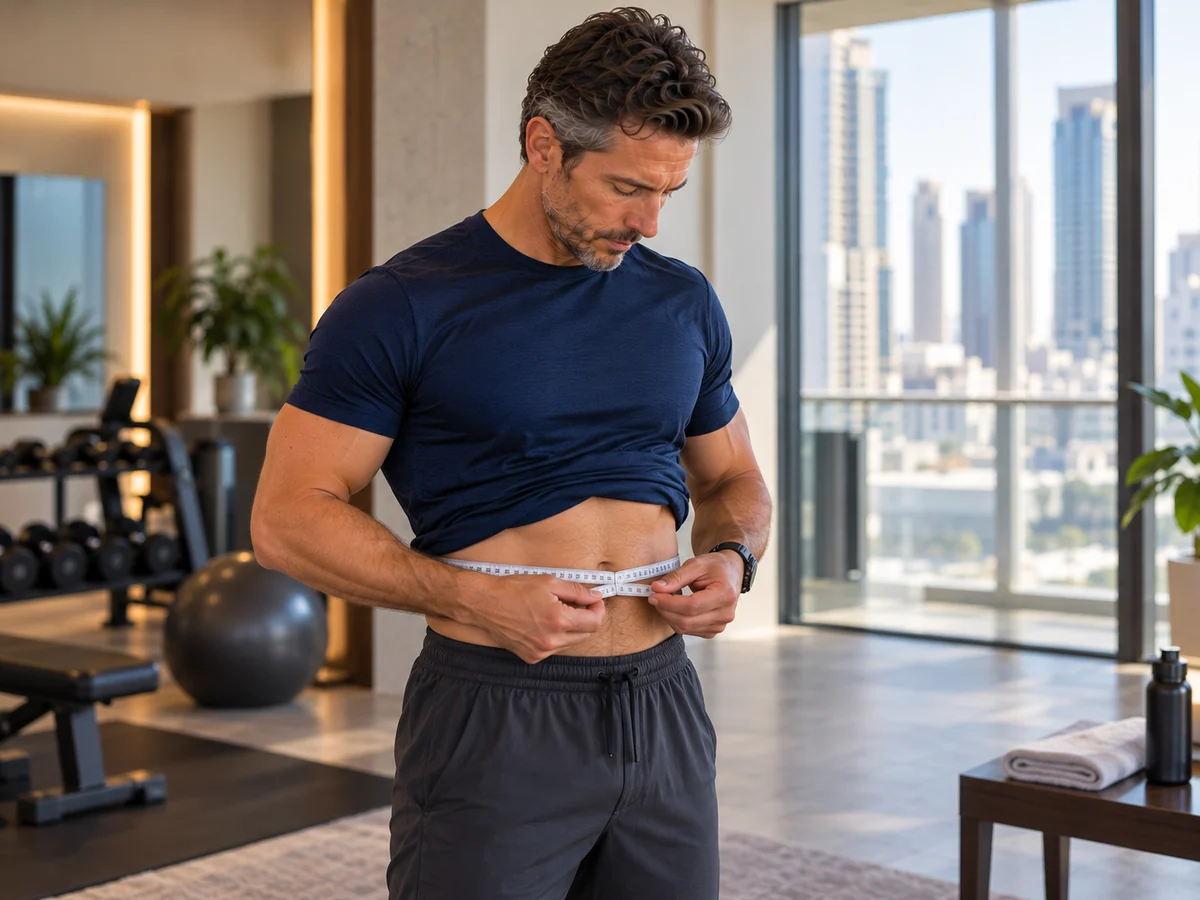
A soft tape measure, used the same way each time, tracks changes in shape that the scale cannot separate from water and food mass. The method matters more than the tool: measure first thing in the morning before eating, at the same points on the body, with the tape snug but not compressing the skin, and record the number rather than trusting memory.
- Waist: at the narrowest point, or level with the navel if there is no clear narrowing, standing relaxed rather than pulled in.
- Hips: at the widest point around the glutes.
- Chest: at nipple level, tape level front and back, breathing out normally rather than at full inhale.
- Thigh and arm: at a marked, repeatable point, such as a set distance below the hip crease or the midpoint between shoulder and elbow, since "halfway" drifts without a landmark.
Measure every two to four weeks rather than daily; shape does not change fast enough for more frequent checks to mean anything, and the extra attention tends to create anxiety rather than insight. A change of a centimetre or two at a given point over a month is a real and meaningful signal, well above the noise of a single measurement.
Progress Photos (Optional)
Photos capture visual changes in shape, posture and muscle definition that the scale and even a tape measure can miss, but they are optional, not a requirement for taking training seriously. If you choose to use them, consistency is what makes them useful: the same three angles (front, side, back), similar lighting, the same distance from the camera, comparable clothing, and a neutral, relaxed stance rather than one deliberately flexed or posed to flatter a particular photo.
Store them privately and only share them if and when you choose to. There is no obligation to keep or compare photos at all if you find them unhelpful or uncomfortable; many people get a perfectly clear picture of progress from measurements, fit and performance alone.
How Your Clothes Fit
Clothing fit is a genuinely useful, if imprecise, everyday indicator. A pair of trousers sitting looser at the waist, a shirt no longer pulling across the shoulders, or a belt moving a notch all reflect real changes in shape, and they cost nothing extra to notice. The limitation is that fit depends on the specific garment, fabric and even the time of day, so treat it as a supporting signal alongside circumferences and photos rather than the single test of progress.
Strength and Performance in the Gym
How much you can lift, for how many controlled repetitions, with good technique and a full range of motion, is one of the more concrete things you can track, and it reflects real adaptation rather than daily water shifts. The qualifier matters: technique, range of motion and effort all have to stay comparable for a heavier lift to actually mean more capable muscle, rather than a shorter range, looser form or a lucky day.
A useful habit alongside the numbers is reps in reserve (RIR): roughly how many more good repetitions you could have done at the end of a set, an approach described for resistance training by Helms and colleagues (2016). Logging load, reps and an honest RIR for your main lifts gives you a trend to judge over weeks, not a single session to judge in isolation.
Important distinctionLifting more weight does not automatically mean more muscle. Much of the strength gained in the first weeks and months of training, or after returning to it, comes from the nervous system learning to recruit muscle more efficiently rather than from the muscle itself growing (Sale, 1988). Strength, muscle size and the number on a scale are three related but genuinely different things, and tracking only one of them tells an incomplete story.

Endurance and the Capacity for Daily Activity
A second, practical performance signal is simply what your body can comfortably do: climbing a few flights of stairs without needing to pause, keeping pace on a walk with family or colleagues, recovering faster between sets, or finishing an errand-heavy day with more left in reserve than a few months earlier. None of this needs a device to notice, and all of it reflects a real improvement in aerobic capacity and general conditioning.
If you want a slightly more structured check, a simple one is repeating the same walk, stair climb or light jog at a fixed, comfortable effort every few weeks and noting the time, the distance, or how it felt. The goal is a rough trend over months, not a competitive time trial.
Consistency, Recovery, Energy and Sleep: Complementary Signals
How consistently you are training, how quickly you recover between sessions, your general energy through the day and the quality of your sleep are genuinely useful context, and worth noticing. They are not, however, direct measures of body composition or strength, and a good night's sleep does not by itself mean you have gained muscle or lost fat any more than a poor one means you have lost ground. Treat them as signals about whether your current routine is sustainable, which matters for whether the other indicators keep moving in the right direction.
Public health guidance on physical activity for adults frames consistency itself as the goal worth tracking: regular activity across the week, rather than any single outstanding session (World Health Organization). If energy and sleep are consistently poor despite steady training, that is worth addressing in its own right, both for how you feel and because it affects every other indicator in this guide.

The Limits of Scales, Body-Fat Estimates and Wearables
Home bioelectrical-impedance scales estimate body fat by passing a small current through the body and inferring composition from how it travels, and the estimate is sensitive to hydration, recent food, and recent exercise; a real-world comparison against a reference method found that even capable modern devices perform best under controlled, consistent conditions rather than casual daily use. Use the same device, at a similar time and hydration state, and read the number as an approximate trend rather than a precise body-fat percentage.
The body mass index (BMI) commonly quoted on scales and charts is a ratio of weight to height, and it does not distinguish fat from muscle or bone, which is explicitly acknowledged in the official guidance on how to use it (Centers for Disease Control and Prevention). A muscular, well-trained person and a sedentary person of the same height and weight can land on the same BMI figure despite very different body compositions. It is a simple population-level screening tool, not a measurement of your personal body composition.
Fitness wearables add a further layer of specific numbers, and they are not equally reliable across what they report. A systematic review of commercially available devices found step counts and heart rate from well-known brands to be reasonably accurate, while estimates of calories burned varied more and depended heavily on the device and the activity (Fuller and colleagues, 2020). Treat a wearable's energy-expenditure number as a rough estimate for comparing your own days, not an exact figure.
Choosing a Few Indicators That Match Your Goal
Trying to track everything in this guide at once is a reliable way to abandon all of it within a month. Pick two or three indicators that genuinely match what you are training for, and let the others go.
| Indicator | How to measure it | Suggested frequency | Main limitation |
|---|
| Body weight | Same time of day, same conditions; use the weekly average | Daily reading, weekly average | Swings with water, food and sodium, not just fat |
| Circumferences | Soft tape, same landmarks, morning, relaxed | Every 2–4 weeks | Small single-point changes can be measurement error |
| Progress photos | Same angles, lighting, distance and clothing | Every 2–4 weeks | Subjective; lighting and pose can distort comparison |
| Clothing fit | Notice the same few reference garments | Ongoing, as noticed | Depends on the specific garment and fabric |
| Strength (load, reps, RIR) | Simple log of weight, reps and effort for main lifts | Every session; review trend every 2–4 weeks | Needs comparable technique and range of motion to mean the same thing |
| Endurance / daily capacity | Repeat the same walk, stairs or light jog at a fixed effort | Every few weeks | Affected by heat, sleep and stress on the day |
A fat-loss goal leans on the weekly weight average, circumferences and photos. A strength or muscle-focused goal leans on the training log, strength numbers and how clothes fit. A general wellbeing goal can rely mostly on consistency, energy and the capacity to do daily activities comfortably, checking the others only occasionally. If you are building a two-day strength plan around clear numbers to track, our guide to a two-day strength training plan for busy professionals in Dubai lays out exactly what to log each session.
Reading a Stable-Looking Period
A few weeks where the scale, the tape measure and the mirror all seem to agree that nothing is happening is common, and it is not automatically a sign that training has stopped working. Before concluding that, check the indicators that often move first: has a lift gone up, even slightly, or do the same reps now feel more controlled? Is a reference garment fitting a little differently? Has a walk or a flight of stairs felt a little easier? Any of these moving while weight and circumferences hold steady is a normal pattern, not a contradiction.
A genuinely flat month across every indicator you track, alongside training that has stayed consistent, is a reasonable point to talk to a coach rather than keep guessing. A second pair of eyes can usually tell quickly whether the issue is the programme, the measurement, recovery, or simply a short plateau that another few weeks will resolve. If a longer break rather than a plateau is behind a stalled picture of progress, our guide to restarting your fitness routine after a long break covers how to judge progress honestly during that specific return.
A Four-Week Example (Illustrative)
The outline below is illustrative, to show how a few indicators move together over a realistic month. It describes no real client and promises no particular outcome; actual results vary by person, starting point and programme.
| Week | Weekly average weight | Waist | Main lift (load × reps) | Notes |
|---|
| 1 | Baseline | Baseline | Baseline | Establish honest starting readings before judging any change |
| 2 | No meaningful change | No meaningful change | Same load, reps feel slightly more controlled | Technique and RIR often move before the tape does |
| 3 | Down slightly | No meaningful change | Small increase in reps at the same load | A single indicator moving is normal, not a full picture yet |
| 4 | Down slightly, trend confirmed | Down about a centimetre | Small load increase | Several indicators now agree; a clearer trend is forming |
Notice that no single week told the full story on its own, and the scale was neither the first nor the only indicator to move. Judging the month as a whole, across several signals, gave a clearer answer than any single week could.
Checklist Before You Start Tracking
- Pick two or three indicators that genuinely match your goal, not every indicator in this guide.
- Standardise the conditions for whichever ones you choose: same time of day, same method, same landmarks.
- Set a check-in interval of two to four weeks for anything other than a daily weight average; resist checking more often than that.
- Judge trends, not single readings and expect some weeks to show nothing on a given indicator.
- Keep it simple enough to sustain a five-minute log every couple of weeks beats an elaborate system abandoned after one.
- Talk to a coach if every indicator you track stays flat for a genuinely full month of consistent training.
When a Coach Can Help
A coach is particularly useful for interpreting a monitoring picture rather than just collecting one: deciding which indicators actually matter for your goal, telling a normal plateau apart from a programme that needs changing, and keeping technique comparable enough that strength numbers mean what they appear to. In-person personal training in Dubai adds hands-on technique checks that make a strength log trustworthy; online performance coaching reviews your log and photos remotely and adjusts the plan accordingly; and a hybrid arrangement combines the two for people who want both.
If strength is the specific area where your tracking has stalled, our practical guide to returning to strength training after 40 covers how to judge progress honestly during that particular rebuild.

Frequently Asked Questions
Should I stop weighing myself altogether?
Not necessarily. The scale is not useless, it is just incomplete and noisy day to day. If weighing yourself regularly does not make you anxious or compulsive, a weekly average can still be one useful input, especially for a fat-loss goal. If it does affect your mood or behaviour, it is entirely reasonable to track other indicators instead and check in less often.
Why did my weight go up after a great week of training?
Most likely water, not fat. Harder or new training causes temporary fluid retention in the muscles as they recover, a full dinner or higher sodium adds water weight overnight, and the digestive tract itself holds mass that varies by when you last ate. None of this reflects a change in body fat, which moves far more slowly than the scale does.
How often should I take circumference measurements or photos?
Every two to four weeks is usually enough to see a real change against the noise of daily variation, and it keeps the habit from becoming a preoccupation. Weekly is defensible if you find it genuinely useful and do not fixate on small differences; daily measuring or photographing adds anxiety without adding information.
My weight and measurements have not changed in three weeks. Does that mean nothing is working?
Not on its own. Check whether strength, reps, technique or how sessions feel have moved before assuming a stall, since those often shift before a tape measure does. A genuinely flat month across every indicator you track is worth a conversation with a coach, but three weeks of a stable scale while strength and performance are improving is a reasonable and fairly common pattern, not a failure.
Is it true that muscle weighs more than fat?
Not exactly, and the common phrase is misleading. A kilogram of muscle and a kilogram of fat weigh the same; a kilogram of muscle simply takes up noticeably less space, because lean tissue is denser than fat tissue. That is why someone can look visibly more defined or a size smaller while the scale barely moves: body composition, not just body weight, has shifted.
Are home body-fat scales and fitness trackers worth using?
They can be useful for a rough trend if you use the same device under similar conditions and read it as one input, not a diagnosis. Home body-fat scales are sensitive to hydration and recent food or exercise, and wearable estimates of calories burned vary meaningfully between brands and activities, even though step counts and heart rate from well-known devices tend to be reasonably accurate. Treat the exact numbers from either as approximate.
Do I need to track everything in this article at once?
No, and trying to is usually counterproductive. Pick two or three indicators that genuinely match what you are training for, track those consistently, and let the rest go. A monitoring routine that takes five extra minutes every two weeks is one you will actually keep; an elaborate one usually gets abandoned within a month.
The Bottom Line
The number on the scale is one noisy signal among several, not a verdict on whether training is working. Circumferences, photos, how clothes fit, strength and performance, endurance, and how you feel and recover each add a piece the scale cannot, and together they give a far steadier picture than any single morning reading. Choose two or three that genuinely match your goal, measure them the same way each time, check in every few weeks rather than daily, and judge the trend rather than the day.
If you would like help choosing the right indicators for your goal and reading them accurately, you are welcome to book a complimentary trial session.
Sources mentioned
- Cleveland Clinic, Why Does My Weight Fluctuate?
- Centers for Disease Control and Prevention, Body Mass Index: Considerations for Practitioners
- Real-world assessment of multi-frequency bioelectrical impedance analysis for measuring body composition (2025)
- Fuller and colleagues (2020), Reliability and Validity of Commercially Available Wearable Devices for Measuring Steps, Energy Expenditure, and Heart Rate, JMIR mHealth and uHealth
- Sale (1988), Neural Adaptation to Resistance Training, Medicine & Science in Sports & Exercise
- Helms and colleagues (2016), Application of the Repetitions in Reserve-Based RPE Scale for Resistance Training, Strength and Conditioning Journal
- World Health Organization, global recommendations on physical activity for health
This article is educational and does not constitute medical advice. Individual needs and responses vary. If you have a medical condition or concerns about rapid or unexplained weight change, consult a qualified professional.