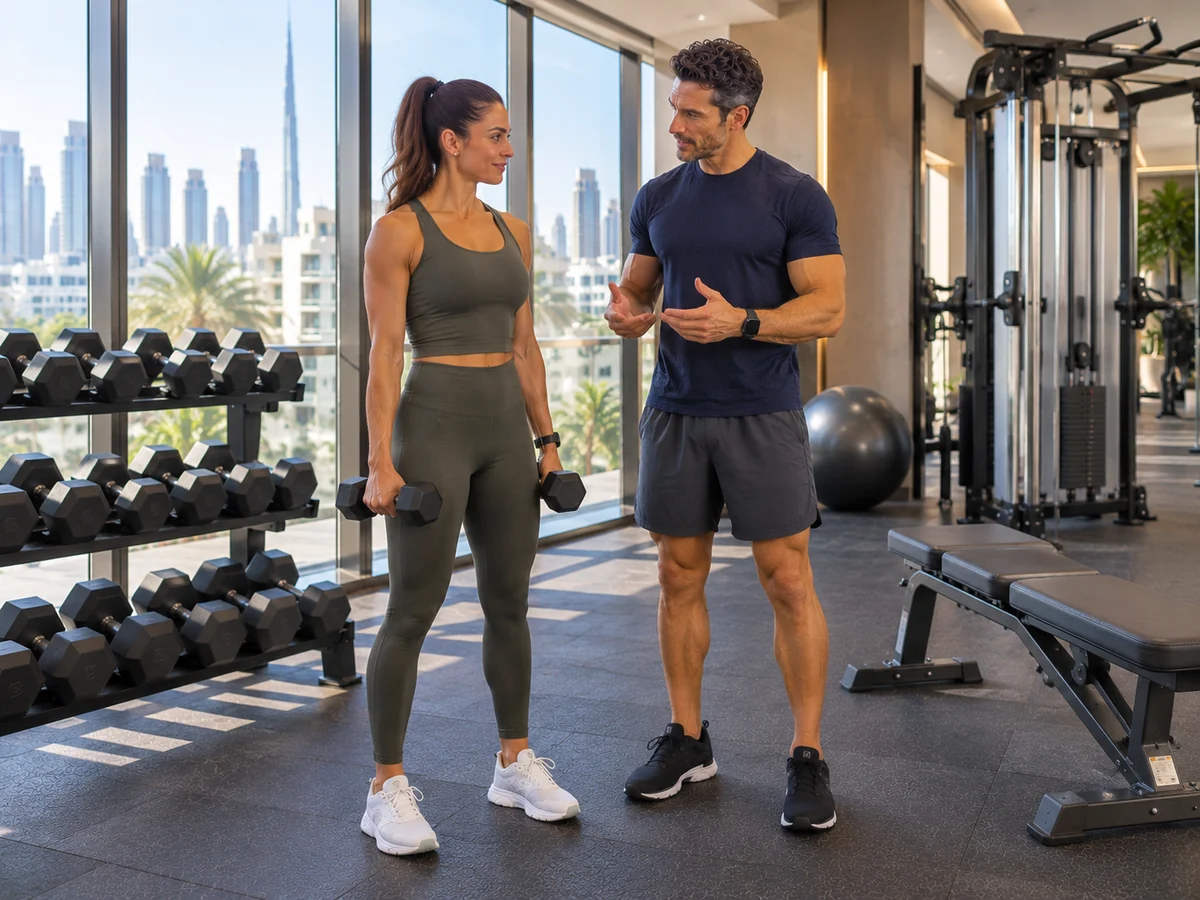
The honest version of "let’s get fit together" usually survives about three weeks. One of you has an early flight, the other has a deadline, the gym session that felt easy to promise becomes impossible to actually schedule, and within a month you are back to training separately, if at all. None of this is really about motivation. It is about building a plan from the start that assumes your two weeks will not match, rather than one that quietly depends on them matching.
That plan is simple to state: fix two sessions a week that you both treat as fixed appointments, agree in advance on a short fallback for the weeks that fall apart, and let one partner skipping a session never be a reason for the other to skip theirs too. The rest of this guide works through exactly how to make each part of that hold up in a real Dubai week, including what to do when your two fitness levels are genuinely different, where to train depending on the heat and the commute, and a simple checklist for planning the week ahead.
Choose Two Sessions You Will Actually Keep
Start from the week you both actually have, not the week you wish you had. Look at both calendars together and find two slots, ideally on the same two days each week, that survive a normal amount of disruption: not the only free evening either of you has, and not a slot that depends on a meeting running on time. Two realistic sessions kept every week beat four ambitious ones that collapse by week three.
Put both sessions in both calendars as named appointments, the same way you would a dinner reservation or a client call. A session that only exists as a shared intention gets quietly dropped the first time something else asks for that hour; a session with a name and a time on the calendar has to be actively cancelled, which is a higher bar.
Agree the fallback at the same time you set the two sessions, not during the week you actually need it. For a week with travel, a late meeting or a sick child, decide now what the short alternative looks like: a fifteen-minute version of the same session, done separately if you are not in the same place, rather than nothing at all. If a busy but non-travelling week is your main obstacle rather than the couple side of it, our guide to staying fit with a busy work schedule in Dubai covers that ground in more detail.
Train Together at Two Different Levels
Sharing a time and a place does not mean doing identical work. The most reliable structure is one shared session format, built around a small set of movement patterns, with the load, the range of motion and the pace adjusted to each person. A squat, a push, a pull and a carry or core movement cover most of what a general session needs, and almost every version of each can be scaled up or down without changing the session’s shape.
Same session, two levels: a concrete example
| Movement | Partner building a base | Partner more advanced |
|---|
| Squat | Bodyweight or a light goblet squat, 3 sets of 10 | Heavier goblet squat or barbell squat, 3 sets of 8 |
| Push | Incline or wall push-up, 3 sets of 10 | Standard or weighted push-up, 3 sets of 10 |
| Pull | Resistance-band row, 3 sets of 12 | Dumbbell or cable row, 3 sets of 10 |
| Carry / core | Plank, 3 rounds of 20 seconds | Loaded carry or plank with added load, 3 rounds of 40 seconds |
Both of you finish each set a few repetitions before it would start to break down, a standard sometimes described as reps in reserve: roughly how many more clean repetitions you could still do (Helms and colleagues, 2016). Judged this way, "the same session" simply means the same four movements and the same rest periods, not the same bar on the rack. A trainer who understands this scaling approach can also design it around specific goals; our comparison of personal training versus online coaching looks at how that kind of individual programming gets delivered.
What to Do When One of You Skips a Session
Agree on this rule before it is tested: one partner missing a session is information about that partner’s week, not an instruction for the other to miss theirs too. The partner who is free does the session, alone if needed, in whatever version fits the time available, full or the short fallback. Waiting for both of you to be free before anyone trains is one of the most common ways a shared routine quietly stops, and our guide to the hidden cost of inconsistency looks at why one missed week so often turns into several.
Avoid turning consistency into a competition. The point of training together is support, not a scoreboard, and treating a missed session as something to keep track of against your partner tends to make the one who missed it less likely to want to resume the shared plan at all. A simple, low-pressure check-in, such as asking whether the other wants company or would rather train solo that day, protects the habit better than a rule about catching up, a pattern our article on why most people quit the gym after three months also points to as a common breaking point.
A Typical Week, Built to Survive a Changed Schedule
Use the table below as a planning template for the week ahead, not a fixed script. The pattern that matters is two protected sessions, a plan B for each, and rest days that do not need defending.
| Day | Planned session | Plan B |
|---|
| Monday | Shared strength session, residence gym, 6:30am | Fifteen-minute bodyweight version at home, done separately if needed |
| Tuesday | Rest or a short walk together | No fallback needed |
| Wednesday | Shared strength session, residence gym, 6:30am | Fifteen-minute bodyweight version at home, done separately if needed |
| Thursday | Rest | No fallback needed |
| Friday | Optional: easy outdoor walk, early morning or after sunset | Skip without guilt if the week has been full |
| Saturday | Flexible: a longer outdoor activity together if the weather allows | Move to an indoor session if it is too hot |
| Sunday | Rest, plan next week’s two sessions together | No fallback needed |
Two fixed weekday sessions plus a flexible weekend option, rather than a dense daily plan, leaves real room for the week to go wrong without the whole routine collapsing with it.
Choosing Where to Train in Dubai
Where you train matters as much as when, mostly because of the heat and the commute. For much of the year, an outdoor session is genuinely harder and less pleasant than the same effort indoors, so building the routine around a residence gym, a home set-up or an air-conditioned facility close to where you live removes a real barrier rather than a minor inconvenience.
- Residence or community gym: the lowest-friction option if your building has one; no commute, no weather decision, and a consistent space you can book into the week without planning around it.
- Home, with minimal equipment: a pair of adjustable dumbbells and a resistance band cover the example session above and remove travel time entirely, which matters most on the weeks that are already tight.
- Outdoor, early or late: reserve this for the cooler months or for early morning and after sunset, and treat it as the flexible weekend option rather than a weekday fixed session, since heat makes it the least reliable choice to plan a fixed appointment around.
If you do choose an outdoor slot, know the signs of heat illness: the CDC lists heavy sweating, dizziness, nausea, headache and cramps among the signs of heat exhaustion, which call for stopping, moving somewhere cool and drinking water; confusion, fainting or very hot skin can signal heat stroke, a medical emergency.
When a Coach Can Help Two Different Levels
A coach is particularly useful when the gap between your two fitness levels, or your two goals, makes it genuinely hard to judge how to scale a shared session safely and keep it progressing for both of you. Rather than each partner following a separate plan that happens to run in the same room, a coach can build one structure that fits both, adjust it as one of you progresses faster than the other, and keep the two sessions genuinely shared rather than two solo workouts that merely overlap in time. If that is where your routine has stalled, our couples personal training page covers how that coaching is structured for two people training together at different levels.
The Bottom Line
A fitness routine that depends on both of your weeks going to plan will not survive many weeks in Dubai. One that assumes they will not, two fixed sessions, a short agreed fallback, and a clear rule for what a missed session means, is far more likely to still be running in six months. Build the version that survives a bad week, not the version that only works on a good one.
If your two fitness levels or schedules have made a shared routine hard to sustain, you are welcome to book a complimentary trial session together.
Sources mentioned
This article is educational and does not constitute medical advice. Individual needs and responses vary. If either of you has a medical condition, an injury or symptoms during exercise, consult a qualified professional before beginning or changing a training routine.