A demanding trip schedule has a way of making training feel optional. The calendar is full of meetings, the gym is unfamiliar or non-existent, sleep comes in short, oddly timed blocks, and by the time you are home the trip has cost you a week or two of training and a few days of catching up on everything else. Multiply that by several trips a month and the routine you built at home quietly disappears.
This guide is about keeping enough going that it does not. It is not about training harder on the road, and it does not promise to protect every number you would hit at home. The aim is continuity: short, realistic sessions that fit a travel day, a sensible way to eat and sleep away from home, and a clear way back into your normal plan once you land. If your main challenge is a busy but non-travelling week, our guide to staying fit with a busy work schedule in Dubai covers that ground; this one is specifically for the travel itself.
Key takeawayOn a trip, aim for continuity, not progress. Pack a short kit, use whatever the hotel gym actually has, keep a genuine no-equipment option for the days with nothing, walk between meetings, protect sleep over a session when the two compete, and resume your normal plan at home rather than trying to make up for lost time.
What "Staying Fit" Means While You Are Away
Training at home and training on the road are different jobs, and treating them the same is a common reason travel wrecks a routine. At home, the goal is usually progress: a little more weight, a few more reps, steady improvement over months. On a trip, the realistic goal is continuity: doing enough, often enough, that your strength, movement quality and habit survive the week largely intact.
That distinction changes what a "good" session looks like away from home. A twenty-minute hotel room circuit that happens is a better outcome than an hour-long plan that gets skipped because it felt like too much to arrange. Judge a trip by whether you did something most days, not by whether any single session matched your usual standard.
Before You Leave: A Short Preparation Routine
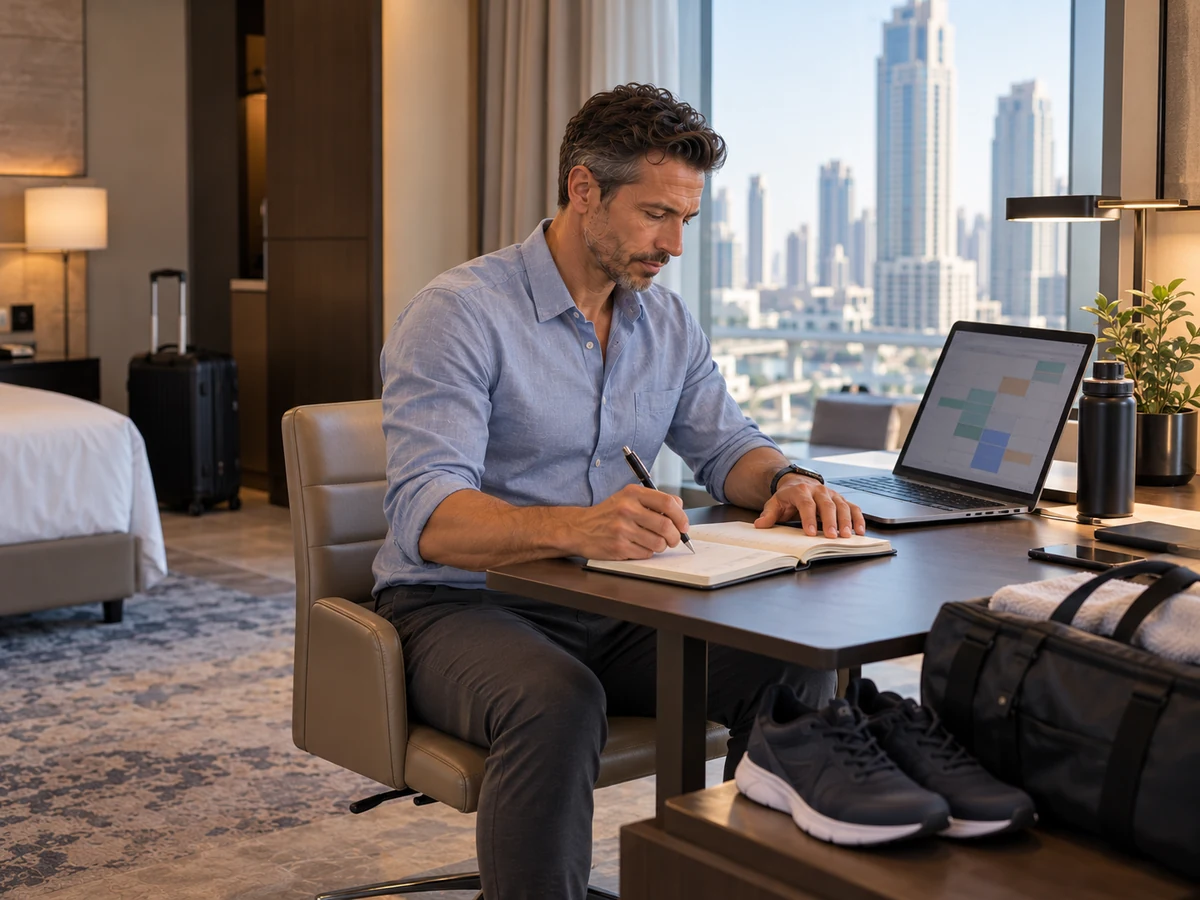
A few minutes of preparation before departure does more for a trip than any amount of willpower once you land. Check your calendar for the days with the least flexibility and the ones with a realistic window, even a short one, and treat those windows as provisional appointments rather than hoping a gap appears. If you know the hotel, a quick look at its gym (size, equipment, opening hours) tells you which of the sessions below to plan for; if you do not, assume the no-equipment option and treat anything better as a bonus.
Pack light, portable kit rather than nothing: a resistance band folds into almost no space and covers rows, presses and lower-body work when there is no gym at all; comfortable shoes make a daily walk realistic even after a long flight. None of this needs to be elaborate. The point of preparation is removing decisions you would otherwise have to make while tired in an unfamiliar city.
Matching the Plan to the Trip
A short trip, one or two nights
For a quick trip, the honest priority is simply not losing the thread. One or two short sessions, or even a single one if the schedule genuinely allows nothing else, is enough to keep the habit alive. Do not try to compress a full week's training into a 36-hour trip; it will not fit, and trying usually means skipping the one session you had time for.
A demanding week of meetings
When the days are full but you are in one place for several nights, look for the windows that repeat: before the first meeting, during a predictable gap, or after the last one ends. Two or three sessions across the week, placed in whichever slots are genuinely protected, beat an ambitious daily plan that competes with every schedule change.
Travel that happens every week
Recurring travel rewards a repeatable routine over a clever one. Settle on one hotel-gym session and one no-equipment session that you can run from memory, in any city, without planning each time. The less a travel routine depends on finding something specific, the more often it actually happens.
Three Ways to Train Away From Home
These are starting points to adapt to what is actually available, not a fixed prescription. In every case, finish each set with a few repetitions still in reserve: travel is not the time to test your limits.
The hotel gym session
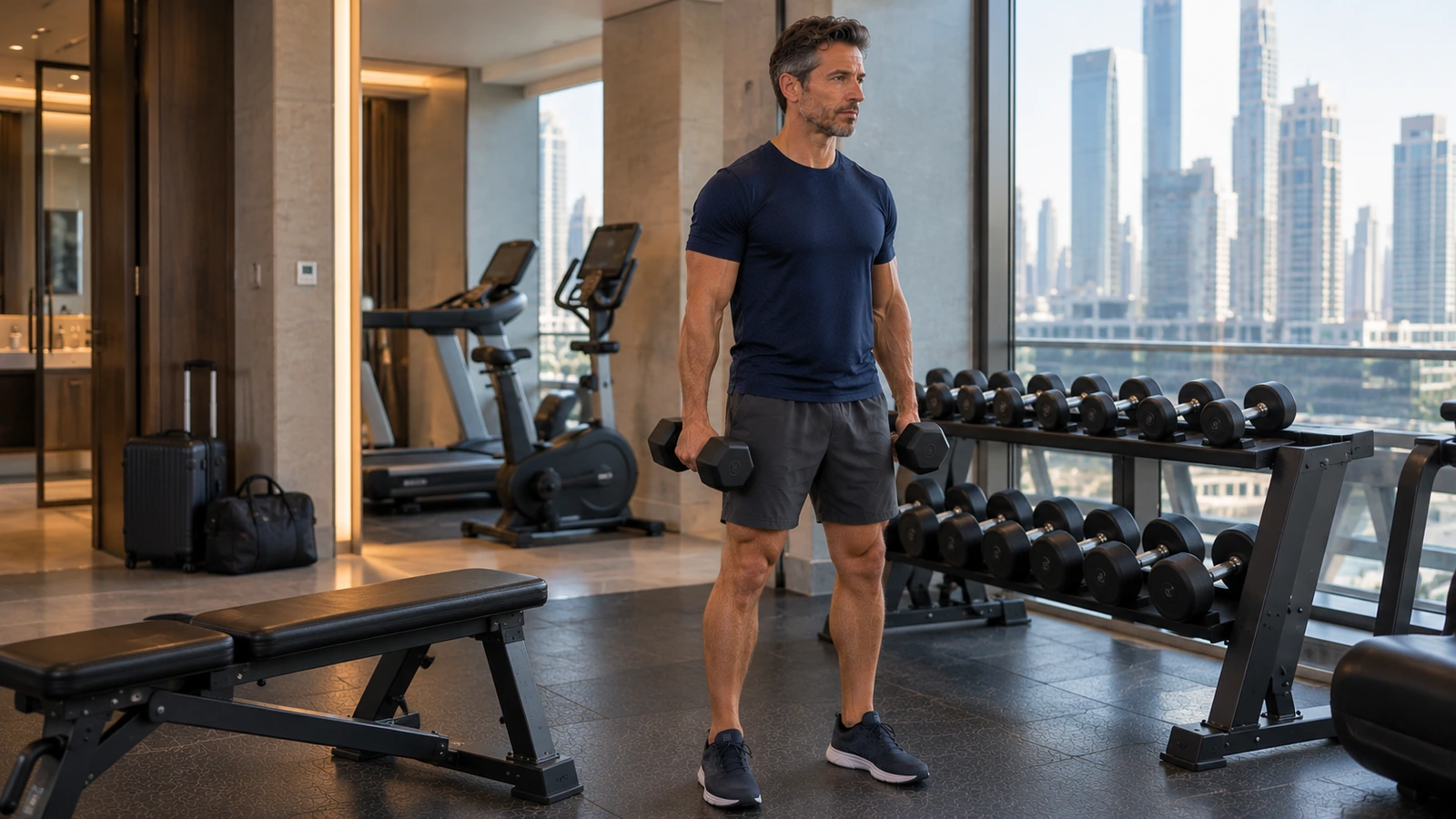
Most hotel gyms have at least dumbbells, a cable station or a few machines, which is enough for a short full-body session covering a squat, a push, a pull and a core or carry movement.
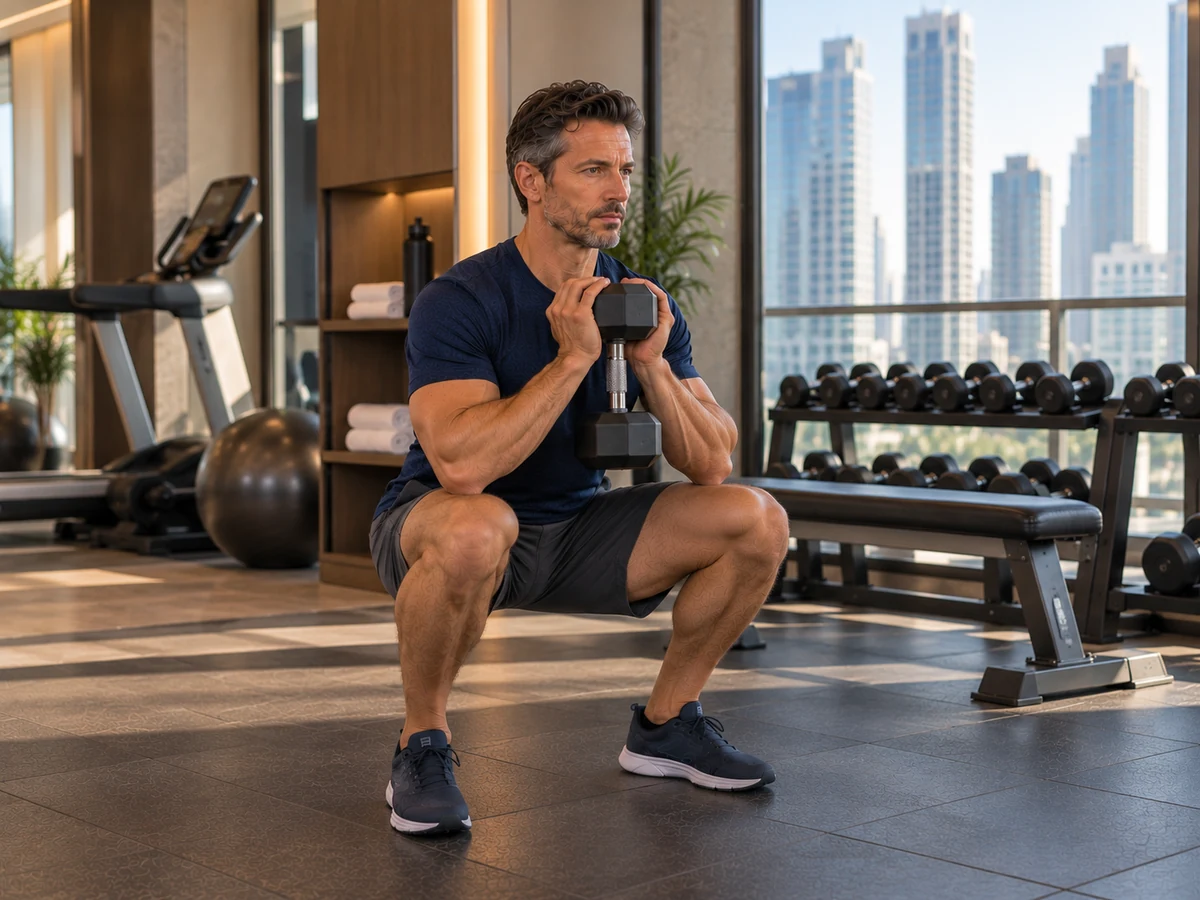
- Goblet squat or leg press: 3 sets of 10 to 12, resting 60 to 90 seconds. No suitable weight available: substitute a bodyweight squat for the same reps.
- Seated row or single-arm dumbbell row: 3 sets of 10 to 12 per side, same rest. No cable or rower: a resistance band row covers the same movement.
- Dumbbell or machine chest press: 3 sets of 10 to 12. No press option: push-ups, hands on the floor or on a sturdy, fixed bench.
- Plank or suitcase carry: 2 to 3 rounds of 30 to 40 seconds, or a short carry across the gym floor and back.
A short warm-up (a few minutes of easy cardio and a couple of light sets of the first exercise) and this session runs about thirty minutes, start to finish.
The no-equipment room session
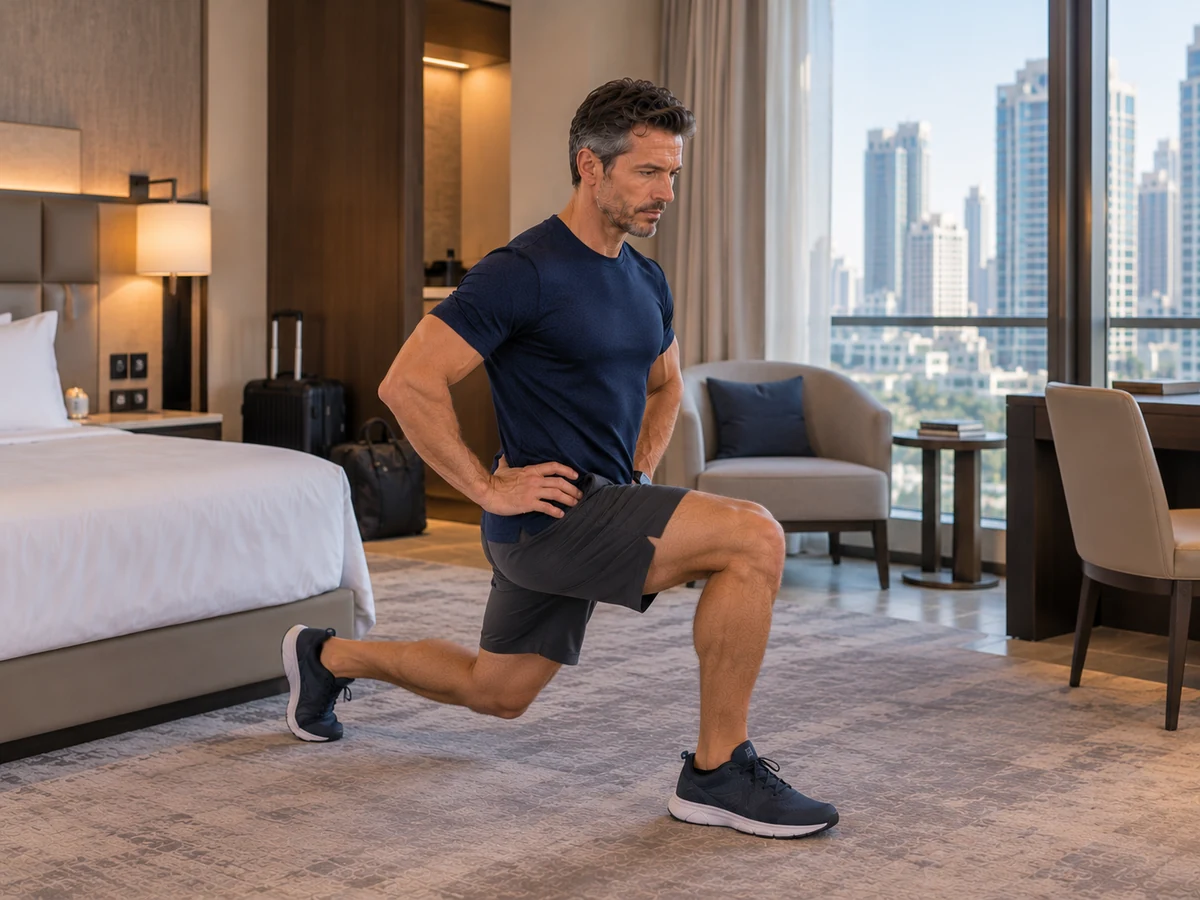
For a room with no gym access at all, floor- and wall-based movements cover the same ground without needing furniture, a door or any improvised anchor.
- Bodyweight squats: 3 sets of 15, resting 45 to 60 seconds.
- Push-ups, hands flat on the floor or standing with hands on a wall: 3 sets of 10 to 15, scaling the angle to keep a few reps in reserve.
- Alternating reverse lunges: 2 sets of 10 per leg.
- Glute bridge: 2 sets of 15.
- Plank: 2 to 3 sets of 30 to 45 seconds.
This runs fifteen to twenty minutes and needs nothing but floor space, which makes it the most reliable option when a hotel gym is small, shared or simply not there.
The ten-minute day
Some days genuinely offer nothing more. On those, a brisk ten-minute walk, or one set each of bodyweight squats and push-ups between calls, is not a workout substitute, but it keeps the habit alive and costs almost nothing to arrange. Treat it as the floor for a bad day, not the target for a normal one.
Matching the Scenario to the Solution
Use the table as a quick reference when you are deciding what a specific day allows, not as a schedule to follow rigidly.
| Scenario | Time available | Practical solution |
|---|
| Short trip, one or two nights | 20 to 30 minutes, once or twice | One hotel gym or no-equipment session; skip the rest without guilt |
| Back-to-back meetings all day | 10 minutes, maybe less | A brisk walk or one short bodyweight circuit between calls |
| An evening genuinely free | 30 to 40 minutes | The full hotel gym or no-equipment session |
| Long-haul flight that day | Little to none | Prioritise sleep and a short walk at the destination; resume the next day |
| Weekly recurring travel | Varies by city | Run the same repeatable hotel gym or no-equipment session everywhere |
Choosing a Manageable Effort When Sleep Is Short
Short nights, time-zone shifts and long days change how hard a given session should feel, even if the exercises look identical to your usual plan. Reduce the load or the number of sets rather than pushing through at your normal intensity, and finish every set with more repetitions in reserve than you would at home. A session that leaves you flat for the rest of the day is a worse trade than a lighter one that still happened.
Technique is the first thing to slip when you are tired, so if a movement starts to feel unstable or poorly controlled, that is the signal to stop the set, not to grind through it. On a trip, a conservative session you complete beats an ambitious one you cut short.
Walking and Movement Between Meetings
A day of back-to-back meetings is also a day of near-total sitting, and that is worth addressing on its own, separately from any formal session. Public health guidance on physical activity includes a simple principle for adults: move more and sit less, and replacing sitting time with light activity reduces health risk even for people who are otherwise inactive. On a travel day this is easy to act on: take calls standing or walking where that is practical, use the stairs instead of a lift between a couple of floors, and walk to a slightly farther coffee point or meeting room rather than the nearest one.
None of this replaces a training session, and it is not meant to. It simply keeps you moving through the parts of a travel day that would otherwise be entirely still, which matters in its own right alongside whatever formal training fits in.

Eating Well Away From Home
Hotel breakfasts, client dinners and room service make it easy to eat irregularly on a trip, which affects energy and sleep more than it affects any single number on a scale. The practical fix is regularity rather than restriction: aim for roughly consistent meal times, include a source of protein at most meals when it is available, and treat buffets and dinners as normal meals rather than events to either overeat at or avoid entirely.
Water is the easiest thing to get wrong while travelling, particularly on flights and in hot climates, so keep a bottle with you and drink through the day rather than only when you notice you are thirsty. This is ordinary travel advice, not a diet plan: the goal is steady energy for the days ahead, not a specific nutritional outcome.
Sleep, Time Zones and Recovery
Sleep is usually the first thing a trip disrupts, and it deserves real priority rather than being the thing you sacrifice to fit in a session. Adults are generally advised to sleep at least seven hours a night (American Academy of Sleep Medicine and Sleep Research Society), and a trip is not an exception worth making a habit of.
For time-zone changes, official travel health guidance focuses on light exposure and timing rather than on exercise or supplements. For a short trip of a couple of days, it can help to keep your sleep and wake times closer to home time; for a longer stay, shifting towards the local schedule, with daylight exposure and regular meals at local times, tends to help you adjust (CDC Yellow Book, Jet Lag Disorder chapter). Staying hydrated and keeping alcohol modest around flights also helps more directly than any training approach. There is no reliable evidence that exercise, fasting or supplements cure jet lag, so treat sleep and light as the main levers and training as secondary.
If a session and a chance to sleep genuinely compete on a travel day, take the sleep. A missed session costs you one day of training; a short night on top of a long day compounds for several.
Coming Home: Resume, Don't Compensate
The trip is over the moment you land, but the temptation to "make up" for a light week often is not. Resist it. Go back to your normal plan at your normal effort rather than scheduling extra sessions or pushing harder to offset what you missed: a punishing catch-up week is a common way an otherwise fine trip turns into a setback.
If jet lag or a short reduction in training has left you tired or a little behind, a day or two of lighter sessions while things settle is sensible; a week of compensatory training is not. For a longer gap than a routine trip caused, our guide to restarting your fitness routine after a long break covers a more gradual return.
When a Coach Can Help
A coach is particularly useful for frequent travellers, because the hard part of training on the road is rarely the exercises themselves; it is adapting a plan to a different city and gym every week without starting from scratch each time. Online or hybrid coaching can plan around a travel calendar before you leave, adjust the session to whatever the hotel gym actually has, and keep the thread between trips so you are not rebuilding the routine every time you come home. If frequent travel is the main disruption to your training, our comparison of personal training versus online coaching looks at which approach fits that pattern best.

Before You Pack: A Checklist
- Check the calendar for the realistic training windows on this trip, and treat them as fixed appointments.
- Look up the hotel gym if you can, or plan on the no-equipment session by default.
- Pack light kit such as a resistance band and comfortable shoes.
- Decide your ten-minute fallback in advance, so a packed day still has an answer.
- Protect sleep over a session whenever the two compete.
- Plan the return as a resumption of your normal plan, not a catch-up week.
Frequently Asked Questions
Is it really possible to stay fit while travelling constantly for work?
Yes, within a realistic definition of "fit". The honest goal on the road is to maintain most of what you have built and keep the habit alive, not to chase new progress every trip. Short, simple sessions done consistently protect far more than occasional long workouts squeezed in only when the schedule allows.
Will I lose muscle if I train less for a week or two?
A short reduction in training, from a few days to around a week or two, typically costs little for someone who has been training regularly. Losses in strength and muscle tend to grow with the length of a break, so the practical goal on a short trip is simply to keep some stimulus going, not to match your usual volume.
What if the hotel gym is tiny or has strange equipment?
Work with what is there rather than trying to recreate your usual session. A squat pattern, a push, a pull and a carry or core movement cover most of what matters, and almost every hotel gym has at least dumbbells or a cable machine for two of those. Treat unfamiliar machines as a bonus, not a requirement.
Is a 10-minute workout actually worth doing?
Yes, when the alternative is nothing. A short session will not replace a full workout, but it maintains the habit and some stimulus, and a week built from several short sessions beats a week with none. Save it for genuinely packed days rather than making it your default.
Does exercise cure jet lag?
No single action cures jet lag, and exercise is not a reliable fix for it. Adjusting sleep and light exposure towards the destination time zone, staying hydrated and avoiding excess alcohol help more directly. Gentle movement can help you feel better, but treat it as one small part of recovery, not a remedy.
Should I train on the first day after a long flight?
Not necessarily, and it is fine to skip it. Give yourself permission to prioritise a short walk, daylight and a normal bedtime over a session on arrival day, then resume your plan once you have had a proper night of sleep. One missed session on travel day is not a setback.
How do I get back into my normal routine after a trip?
Resume your usual sessions at your usual effort rather than trying to make up for lost time with a harder week. A day or two of lighter loads while technique and energy catch up is sensible; a punishing catch-up week is not. Continuity matters more than compensation.
The Bottom Line
Frequent business travel does not have to mean starting over every time you land. A short kit, a repeatable hotel gym session, a genuine no-equipment option, some walking between meetings, and sleep taken seriously are enough to keep most of what you have built intact. Save progress for home, and let travel weeks be about continuity instead.
If you would like a training plan built around your actual travel calendar, you are welcome to book a complimentary trial session.
Sources mentioned
This article is educational and does not constitute medical advice. Individual needs and responses vary. If you have a medical condition, a sleep disorder or symptoms during exercise or travel, consult a qualified professional.