Yes, you can build real strength in a residential gym with limited equipment, but how far that takes you depends on three things: your starting level, the heaviest loads actually available, and whether your training progresses on purpose rather than repeating the same session indefinitely. A building gym with a rack of dumbbells, a bench and maybe a cable stack is enough for most people to make real progress for a long time, as long as the plan accounts for what is actually there.
This guide covers how to assess what your building’s gym really offers, how to organize training around a small set of movement patterns, and how to keep progressing once adding weight stops being an option every week, with a practical two-session example and an honest look at when equipment genuinely becomes the limiting factor. If you already have a structured plan, our two-day strength training plan for busy professionals pairs naturally with the equipment-specific advice here.
Start With What Your Gym Actually Has
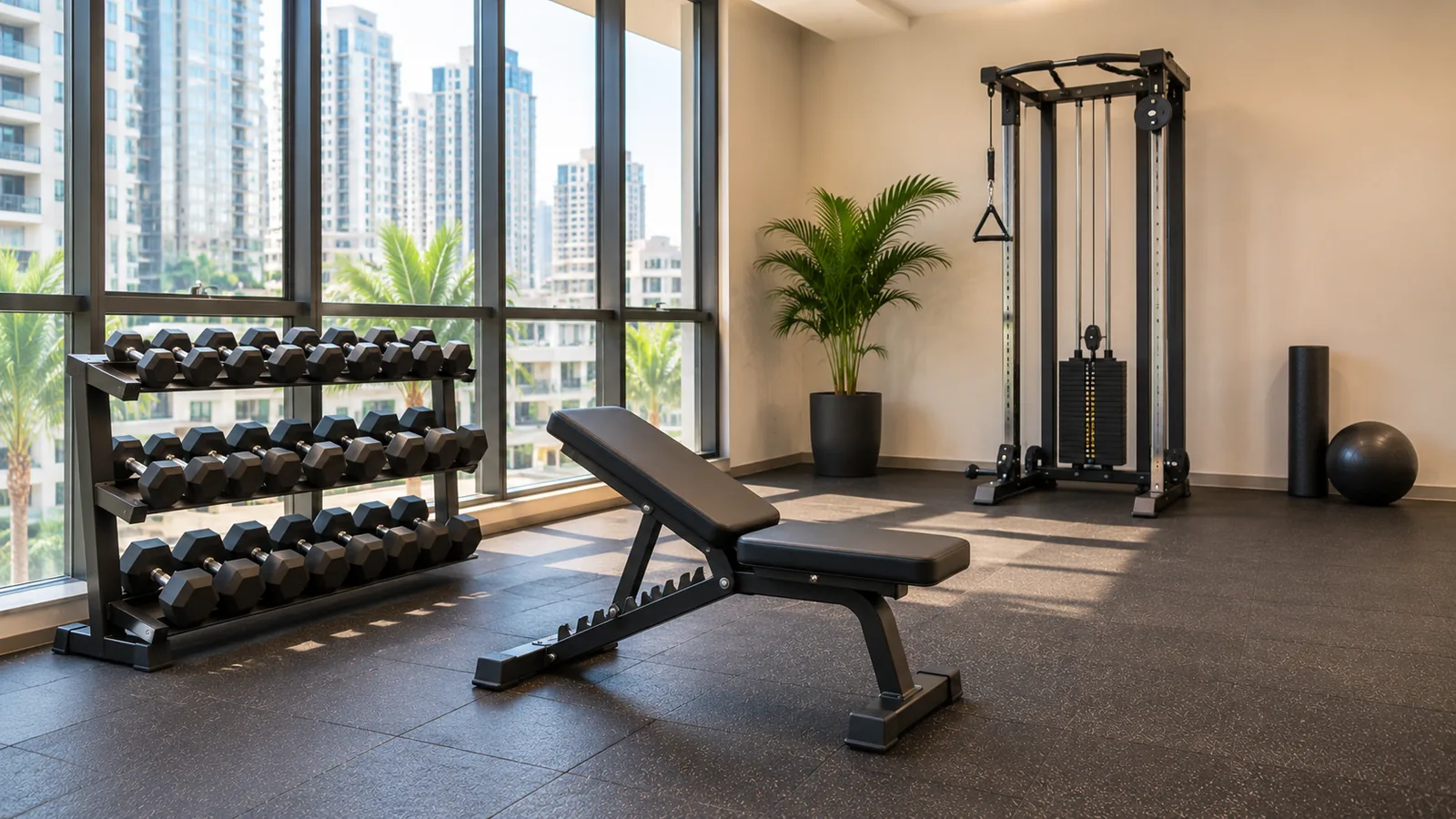
Residential gyms in Dubai vary enormously between buildings, so the first real step is an honest inventory, not an assumption: the full range of dumbbells and their heaviest pair, whether there is an adjustable or flat bench, any cable machine or selectorized equipment and its weight range, resistance bands, and how much floor space you genuinely have to move in.
Check the practical details too: whether the heaviest dumbbells are realistically liftable off the rack safely, whether the bench is stable, and whether the space allows a full range of motion for the movements you plan. A gym that looks well equipped but has worn, wobbly or mismatched equipment is a safety question as much as a programming one.
Organize Training Around Movement Patterns, Not Machines
Once you know what you have, build the plan around a small set of movement patterns rather than a specific machine: a squat, a hip-hinge, a push, a pull, and some trunk or core work. Almost any residential gym can cover all five with some combination of dumbbells, a bench, cables and bands.
- Squat: goblet squat or dumbbell front squat with dumbbells; leg press or a squat-pattern machine if available.
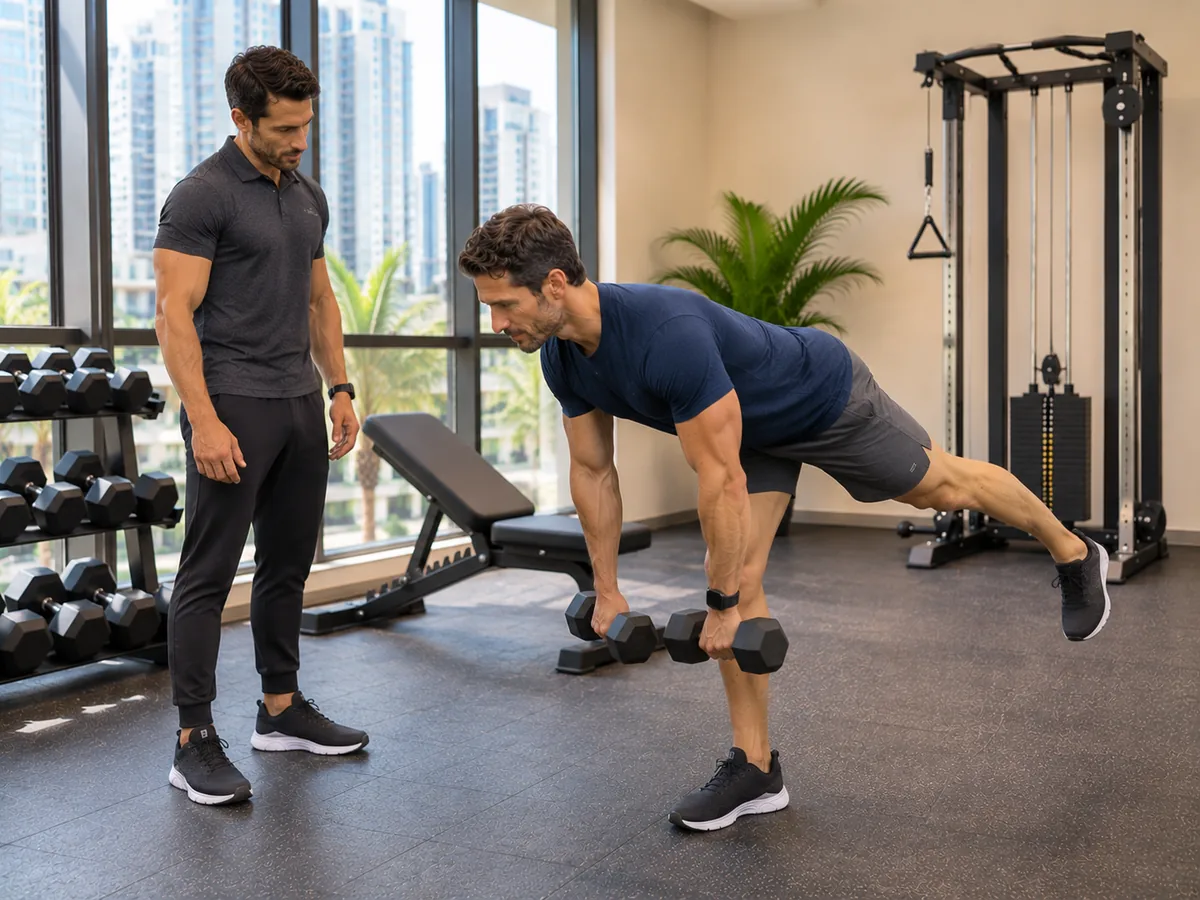
- Hinge: dumbbell Romanian deadlift or single-leg Romanian deadlift; a cable or machine hip-hinge variant where the dumbbells run out too early.
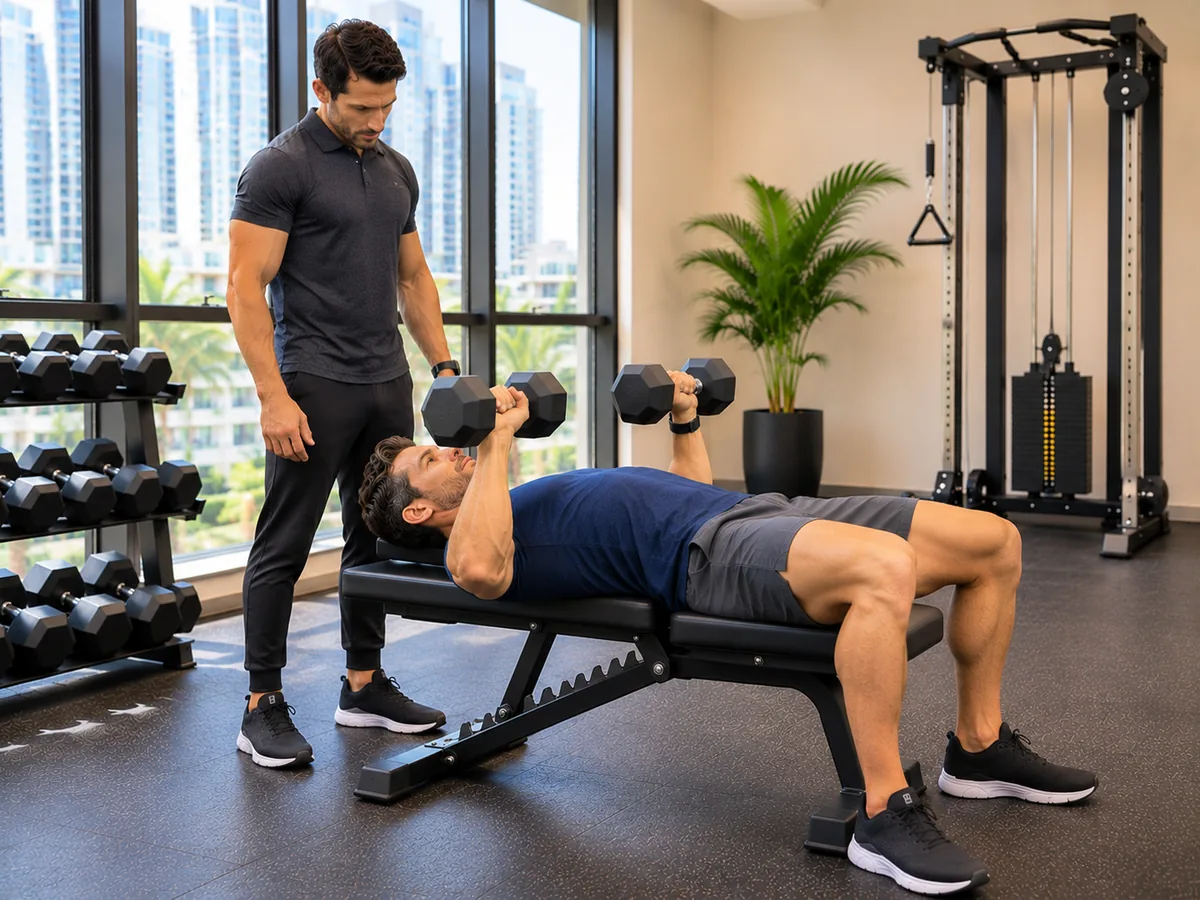
- Push: dumbbell bench press or floor press, overhead press; cable or machine chest and shoulder press as an alternative.
- Pull: single-arm dumbbell row, cable or band row; a lat pulldown machine if the building has one.
- Trunk / core: plank variations, dead bug, loaded carries with the heaviest dumbbells you can hold safely.
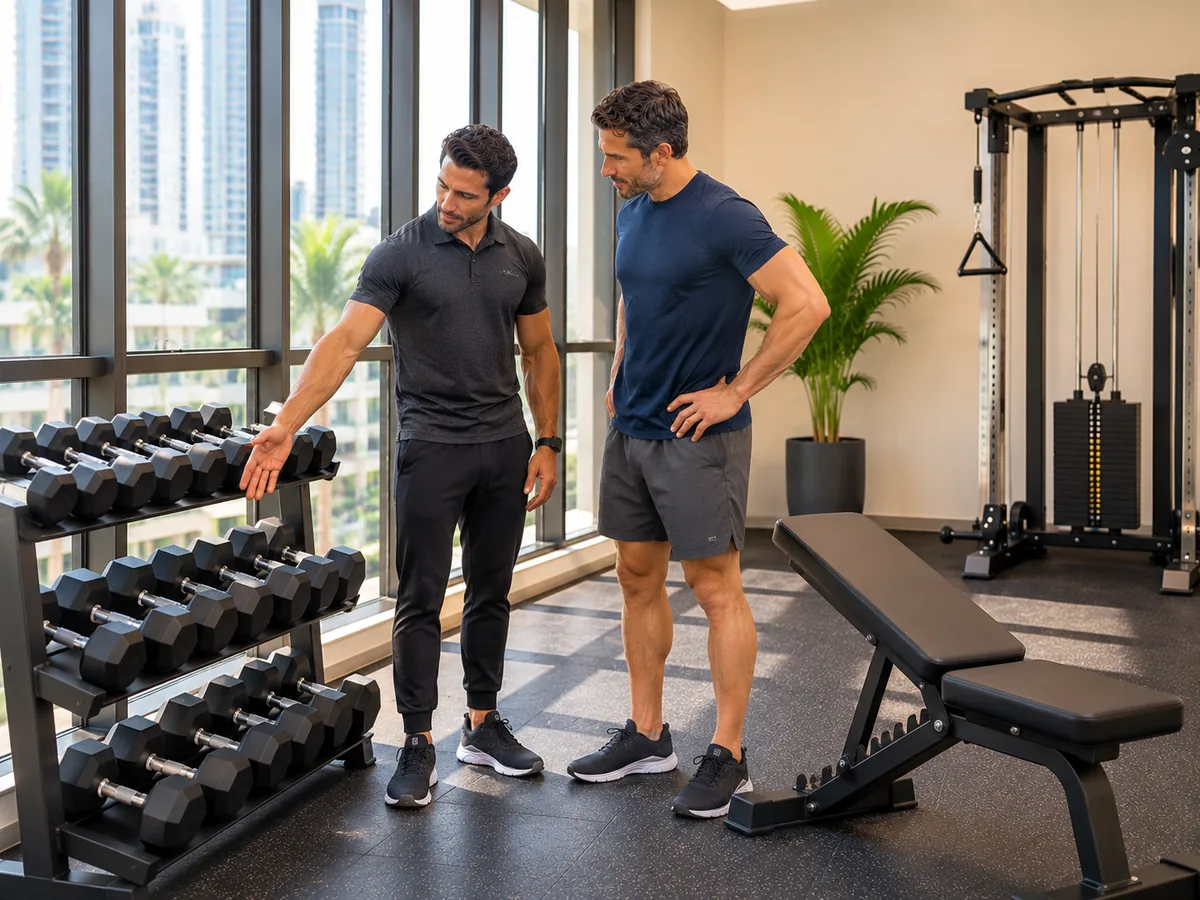
A trainer who understands how to fit a real programme to whatever a specific building actually offers can also judge which substitutions genuinely preserve the training effect and which ones quietly do not; our guide to what to expect from your first personal training session covers how that assessment typically works.
How to Progress Without Constantly Adding Weight
Once the heaviest dumbbell in the building is no longer the ceiling, progression has to come from somewhere else: more reps per set, more total sets, a slower or more controlled range of motion, single-limb variations that load one side harder with the same weight, or a technically harder version of the same movement.
It is worth being honest about the trade-offs. Training closer to failure, or slowing the tempo down, reliably makes a session feel harder, but that is not the same as reliably making you stronger. A meta-analysis by Schoenfeld and colleagues (2017) found that maximal strength gains specifically tend to favour heavier relative loads where they are available, while muscle growth can be achieved across a wider range of loads; higher-rep, lighter-load work is a useful substitute when heavier weight is not available, not an automatic equivalent to it. In practice, use reps, range of motion and unilateral variations deliberately, as planned progression, tracked and built on week to week with a rep or two in reserve (Helms and colleagues, 2016), rather than as a way to make every session maximally exhausting.
A Practical Two-Session Example
The table below is an illustrative example built around common residential-gym equipment, dumbbells, a bench and a cable or band option, meant as an adaptable starting point rather than a universal prescription. Alternate the two sessions through the week with at least one rest or light-activity day between them.
| Session | Movement | Sets x reps | Rest |
|---|
| A | Goblet or dumbbell front squat | 4 x 6–8 | 90–120s |
| A | Dumbbell bench or floor press | 4 x 6–8 | 90–120s |
| A | Single-arm dumbbell row | 3 x 8–10 per side | 60–90s |
| A | Plank or loaded carry | 3 x 30–45s | 45–60s |
| B | Dumbbell Romanian deadlift | 4 x 6–8 | 90–120s |
| B | Dumbbell overhead press | 3 x 8–10 | 90s |
| B | Cable or band row | 3 x 10–12 | 60–90s |
| B | Single-leg Romanian deadlift | 3 x 8–10 per side | 60–90s |
Where a movement’s dumbbells run out before the rep range does, that is exactly the point to substitute in a cable, machine or band variant of the same pattern rather than abandoning the movement entirely.
How to Tell You Are Actually Progressing
- Keep a simple log: weight, sets and reps for each movement, even a basic note in your phone. Memory alone makes slow progress invisible.
- Watch your technique, not just the number: a heavier set with sloppy range of motion is not the same progress as a controlled one.
- Track consistency: a slightly lighter session done every week beats an ambitious one done every third week.
- Expect progress to slow: early gains come quickly for most beginners; a plateau after some months is normal, not a sign the plan has failed.
If you are coming back to training after time off rather than starting fresh, the pace and expectations differ somewhat; our guide to returning to strength training after 40 covers that side of the equation in more depth.
Common Mistakes in a Residential Gym Setting
- Switching the whole programme every few weeks, before any version of it has had time to actually produce progress.
- Using light loads indefinitely without a real plan to progress reps, range of motion or variation over time.
- Cutting rest periods short specifically to make a session feel harder, which usually just reduces the quality of the next set.
- Sacrificing technique and range of motion to handle a heavier dumbbell than can actually be controlled well.
When Equipment Really Becomes the Limit
For a genuine beginner or intermediate lifter, a residential gym’s equipment is rarely the binding constraint for months, sometimes longer; programming, consistency and recovery matter far more. Equipment becomes a real limit mainly for people already reasonably strong and chasing further maximal-strength gains specifically, where heavier absolute loads genuinely make a measurable difference (Schoenfeld and colleagues, 2017) and no amount of extra reps or unilateral work fully substitutes for them.
When a Coach Can Help in Your Residential Gym
A coach is particularly useful once a building’s equipment stops being the obvious constraint and the real question becomes how to structure progression, substitutions and recovery around exactly what that specific gym offers, rather than a generic plan. If that is where your training has stalled, our Personal Training page covers how that coaching is structured, including a complimentary trial session to assess your goals, experience and the equipment actually available to you before anything is agreed.
Checklist Before Your Next Session
- Inventory your building’s equipment honestly: heaviest dumbbells, bench, cables, bands, floor space.
- Pick one movement per pattern, squat, hinge, push, pull, trunk, and a sensible alternative for each.
- Decide your progression tool for the week: reps, range of motion, tempo or a unilateral variation, not just whether the weight went up.
- Log what you actually lifted, so next week’s progress is a decision, not a guess.
- Protect your rest periods rather than cutting them short to feel more tired.
Frequently Asked Questions
The Bottom Line
A residential gym with limited equipment is enough to build real strength for most people, for longer than it usually feels like it should be. The plan that works is built around an honest read of what your building actually offers, organized by movement pattern rather than by machine, and progressed on purpose once the dumbbells alone stop being the answer.
If you would like help building that plan around your specific building’s equipment, you are welcome to book a complimentary trial session to talk through your goals, experience and what is actually available to you.
Sources mentioned
This article is educational and does not constitute medical advice. Individual needs and responses vary. If you have a medical condition, an injury, or are new to resistance training, consult a qualified professional before beginning or changing a training programme.